
The strongest warehouse management picks for 2026 split by operational profile: Oracle Fusion Cloud Warehouse Management leads for enterprises running heavy automation, NetSuite Warehouse Management wins for mid-market teams already on NetSuite ERP, and Zoho Inventory or SkuVault fit SMB and ecommerce sellers that need accuracy without enterprise overhead. A full comparison and buying checklist follow below.
TL;DR:
- Most midsize implementations take eight to sixteen weeks; integration testing and staff training cause the most delays, while migration and support add costs beyond subscriptions.
- Before demos, map order volume, SKU complexity, automation plans, and required system connections, then ask which integrations are native and which require custom work.
- SMB tools can launch faster because they need less configuration, but brands that outgrow them may face a second migration within two to three years.
- Brands with unpredictable volume or no dedicated warehouse staff can test outsourced fulfillment through a 30 to 90 day pilot before committing to WMS implementation.
- Midmarket buyers often gain more from warehouse tools tied to their ERP, which keep finance and sales data together, than from unused enterprise automation.
Table of Contents
- Shortlist: The Best WMS Software for Every Operation Size
- Side-by-Side Comparison: WMS Options by Buyer Profile
- How to Choose a WMS: Checklist and Demo Questions
- How We Selected and Compared Vendors
- Publisher Perspective: When Outsourcing Warehousing Beats Buying a WMS
- Core WMS Capabilities Every Buyer Should Expect
- Automation and Robotics: How Ready Is Each Platform for AI?
- Integration With ERP, Ecommerce, and Transportation Systems
- Support, Training, and Onboarding: What to Expect Across Vendors
- Security and Compliance Features to Look For
- What Small and Mid-Size Brands Actually Experience
- What the Research Actually Supports
- A Faster Path Than Buying and Running a WMS Yourself
- FAQ
- Sources
Shortlist: The Best WMS Software for Every Operation Size
Picking a warehouse management system starts with matching the platform to your order volume, SKU complexity, and growth plan, not the vendor with the longest feature list. The options below cover the range most operations teams actually consider in 2026, from enterprise suites to lean ecommerce tools.
Oracle Fusion Cloud Warehouse Management anchors the enterprise tier. Oracle reports being named a Leader in Gartner’s 2026 Magic Quadrant for the eleventh consecutive year, and it leans on AI-powered fulfillment and real-time inventory visibility to support high-automation distribution centers.
SAP Extended Warehouse Management (SAP EWM) suits companies already running S/4HANA that want warehouse execution tied directly to their ERP backbone, with deep support for labor management and yard operations.
Manhattan Active WMS (Manhattan Associates) is built for high-volume distribution and omnichannel retail, with one of the widest robotics and materials-handling integration ecosystems on the market.
Blue Yonder Warehouse Management fits global retailers that need broad integration coverage across regions and fulfillment networks, drawing on mature, large-scale deployments.
NetSuite Warehouse Management works best for mid-market companies that already run NetSuite ERP and want warehouse operations folded into the same system instead of bolted onto a separate platform.
Infor WMS (also sold as Infor CloudSuite WMS) stands out for industry-specific configurations, useful for food and beverage, 3PL, or manufacturing operations that need vertical templates out of the box.
Microsoft Dynamics 365 Supply Chain Management extends warehouse capabilities through Dynamics 365 Business Central and marketplace add-ons, a fit for companies already standardized on Microsoft’s supply chain stack.
Softeon Warehouse Management and Körber Warehouse Management System both serve mid-size to large distribution operations looking for configurable execution logic without a full enterprise ERP commitment.
For smaller operations, Fishbowl WMS, Zoho Inventory, SkuVault, and Odoo WMS round out the SMB and ecommerce tier:
- Fishbowl WMS: simple deployment, SMB pricing, solid for companies graduating from spreadsheets.
- Zoho Inventory: affordable, strong ecommerce integrations, best for small retail and DTC brands with simple operations.
- SkuVault: built around inventory accuracy and reconciliation for ecommerce-first sellers.
- Odoo WMS: an open-source ERP with an integrated warehouse module, a fit for SMBs that want customization without enterprise licensing costs.
Niche options worth knowing: Extensiv / 3PL Warehouse Manager and EasyEcom target third-party logistics providers managing multiple client inventories, while Cin7, Brightpearl, and Logiwa WMS serve omnichannel retailers juggling several sales channels from one stock pool.
Side-by-Side Comparison: WMS Options by Buyer Profile
The table below lines up the shortlist against the axes that matter most when narrowing a vendor list: who the platform fits, how it deploys, and what it leans on to win deals.
| Software | Best for | Deployment model | Typical buyer size | Standout capability |
|---|---|---|---|---|
| Oracle Fusion Cloud Warehouse Management | Complex automation and robotics at scale | Cloud | Large enterprise | AI-driven fulfillment optimization |
| SAP Extended Warehouse Management | SAP-centric enterprises | Cloud or on-premises | Large enterprise | Native ERP and S/4HANA integration |
| Manhattan Active WMS | High-volume omnichannel distribution | Cloud-native | Large enterprise | Broad robotics ecosystem |
| Blue Yonder Warehouse Management | Global retail networks | Cloud | Large enterprise | Mature multi-region deployments |
| NetSuite Warehouse Management | NetSuite ERP users scaling operations | Cloud | Mid-market | Integrated ERP and WMS data |
| Infor WMS | Vertical-specific operations | Cloud or on-premises | Mid-market to enterprise | Industry configuration templates |
| Microsoft Dynamics 365 Supply Chain Management | Microsoft-standardized supply chains | Cloud | Mid-market to enterprise | Native Dynamics 365 integration |
| Softeon Warehouse Management | Configurable mid-size distribution | Cloud or on-premises | Mid-market | Flexible execution logic |
| Fishbowl WMS | SMBs leaving manual tracking | On-premises or cloud | Small to mid-size | Low-friction setup |
| Zoho Inventory | Small ecommerce and retail brands | Cloud | Small business | Ecommerce platform integrations |
| SkuVault | Ecommerce sellers needing accuracy | Cloud | Small to mid-size | Inventory reconciliation tools |
| Odoo WMS | SMBs wanting ERP plus WMS in one | Cloud or on-premises | Small to mid-size | Customizable modules |
A few patterns stand out once the options sit side by side:
- Enterprise picks cluster around automation and robotics, which tracks with Gartner’s Critical Capabilities framework, which evaluates vendors on adaptability, analytics, and robotics support across more than 20 solutions.
- Mid-market buyers gain the most from ERP-native options like NetSuite or Dynamics 365, since warehouse data stays in the same system as finance and sales.
- SMB and ecommerce sellers should weight integration speed and predictable pricing over feature breadth. Capterra’s comparative data shows NetSuite, Odoo, and Fishbowl among the most reviewed products in this tier.
- Forrester’s Q2 2026 landscape covers eleven vendors and recommends shortlisting by operational objective rather than brand recognition alone.
- Vendors named in Gartner, Forrester, or Capterra reports carry more third-party validation than those relying only on vendor-published case studies.
How to Choose a WMS: Checklist and Demo Questions
Before scheduling demos, settle the operational facts that actually narrow the field: order volume, SKU count, how much picking is automated today, and which systems the WMS needs to talk to.
- Map your volume and SKU complexity. A platform built for a few hundred orders a day behaves differently under five thousand.
- List every system that needs to connect. ERP, ecommerce storefronts, and transportation management all need clean data flow in and out.
- Decide how much automation you already run or plan to add. Conveyor, robotics, and voice-picking support vary widely across vendors.
- Estimate total cost of ownership, not just license or subscription fees. Implementation, training, and integration work often cost more than the software itself.
- Check vendor viability. A platform with analyst coverage and a visible customer base is less likely to leave you stranded mid-contract.
When you get vendors on a call, ask pointed questions: How long did a similar-sized customer take to go live? What happens to picking accuracy during peak season? What’s included in support versus billed as a separate service? A vendor that answers with specific timelines and named modules is giving you something to verify; one that answers only in generalities is a flag worth noting.
Most mid-market implementations run eight to sixteen weeks from contract to go-live, with integration testing and staff training as the two most common sources of delay. Cost drivers beyond the subscription typically include data migration, custom integration builds, and ongoing support tiers.
Pro Tip: Ask each finalist vendor for a reference customer at your order volume, not just their largest logo.
How We Selected and Compared Vendors
This shortlist draws on three types of sources: analyst research, review aggregators, and vendor-published results. Gartner’s Magic Quadrant and Critical Capabilities framework evaluates more than 20 WMS platforms across eleven capability areas, which gives a consistent basis for comparing enterprise fit. Forrester’s WMS landscape report adds vendor differentiation by size and offering type across eleven vendors. Capterra’s WMS category supplied review-based popularity signals for SMB-tier products.
- Selection favored platforms available to U.S. buyers with documented analyst or review coverage.
- Operational fit (enterprise, mid-market, SMB) weighed more heavily than feature count alone.
- This list has limits: analyst reports update periodically, and pricing shapes shift. Run a demo or short pilot before signing anything long-term.
Publisher Perspective: When Outsourcing Warehousing Beats Buying a WMS
Not every growing brand needs to own a warehouse management system. When order volume is still unpredictable or a team lacks dedicated warehouse staff, outsourcing to a third-party logistics provider often delivers inventory visibility and fulfillment speed faster than implementing software in-house. We built our 3PL and warehousing services around exactly that gap: live inventory data, same-day shipping for orders placed by 1PM CST, and no long-term contracts, so brands get WMS-level visibility without buying or maintaining the system themselves.
Core WMS Capabilities Every Buyer Should Expect
Every platform on this list handles the same operational backbone: receiving, put-away, picking, packing, shipping, and inventory visibility. Receiving confirms inbound stock against purchase orders and flags discrepancies before they reach the shelf. Put-away logic decides where that stock goes, often optimizing for pick-path efficiency rather than simple open-slot assignment.
Picking is where most platforms differentiate, through wave picking, zone picking, or batch picking depending on order profile. Packing confirms the right items and quantities before a label prints, and shipping integrations generate carrier labels and tracking data automatically. Inventory visibility ties it together: a real-time view of what’s on hand, what’s allocated, and what’s in transit across every location.
The depth of each function varies by tier. Enterprise platforms like Manhattan Active WMS or SAP EWM support complex slotting algorithms and multi-node inventory visibility across dozens of facilities. SMB tools like Fishbowl WMS or Zoho Inventory cover the same five functions with simpler logic suited to single-warehouse operations. Neither approach is wrong, but a mismatch between capability depth and actual need is one of the most common reasons implementations stall or get abandoned mid-rollout.
Automation and Robotics: How Ready Is Each Platform for AI?
Cloud-native platforms built or rebuilt for 2026 lean heavily on automation and AI readiness as a selling point. Oracle’s announcement of its Gartner Leader status specifically cites AI-powered fulfillment and advanced warehouse automation as differentiators, and Manhattan Active WMS carries one of the broadest robotics and materials-handling integration ecosystems among enterprise platforms.
Market commentary tied to Gartner’s 2026 Magic Quadrant coverage points to three shifts reshaping buyer priorities: cloud-native and composable architecture, AI- and automation-readiness as a baseline expectation rather than an add-on, and convergence of WMS with transportation and returns management into one execution layer.
For buyers evaluating automation claims, specificity matters more than marketing language. Ask any vendor for a concrete example of a customer deployment involving robotics or vision systems, along with performance data from that rollout. A vendor that can name the integration partner and describe the measurable outcome is giving you something to check; one that speaks only in capability terms is not. Smaller operations without robotics on the roadmap yet should weight this category less. AI-readiness matters more when automation is already part of the plan, not as a requirement for every warehouse regardless of size.

Integration With ERP, Ecommerce, and Transportation Systems
A WMS that cannot talk to your ERP, storefront, and carriers becomes another data silo instead of a control center. NetSuite Warehouse Management and Microsoft Dynamics 365 Supply Chain Management solve this by living inside the ERP itself, so inventory, orders, and fulfillment share one database instead of syncing between two systems.
SAP EWM takes the same approach for S/4HANA environments, while Infor WMS and Softeon Warehouse Management support integration through middleware for companies running separate ERP platforms. On the ecommerce side, Zoho Inventory, SkuVault, Cin7, and Brightpearl all build in direct connections to common storefront platforms, which matters for DTC brands that need stock counts to update the moment an order comes in.
Transportation management integration is where the 2026 trend toward convergence shows up clearly: several platforms now bundle TMS-style carrier selection and rate shopping directly into the warehouse workflow rather than treating shipping as a separate system. When comparing vendors, ask specifically which ERP, ecommerce, and carrier integrations ship natively versus which require a third-party connector or custom build, since that difference affects both implementation time and ongoing maintenance cost.
Support, Training, and Onboarding: What to Expect Across Vendors
Support quality varies as much as feature sets across this list, and it rarely shows up clearly in a sales deck. Enterprise vendors like Oracle, SAP, and Manhattan Associates typically offer tiered support agreements with defined response times, dedicated implementation teams, and formal training programs built into the onboarding contract.
Mid-market and SMB platforms handle support differently. Some, like NetSuite, lean on a partner network for implementation and training rather than direct vendor staff. Others, like Fishbowl WMS or Zoho Inventory, bundle basic onboarding into the subscription and charge separately for advanced configuration help.
Before signing, ask each vendor exactly what’s included: is training a one-time session or ongoing access to resources? Is support staffed around the clock, or limited to business hours? What’s the actual guaranteed response time for a critical issue, in writing, not as a verbal assurance? A platform that performs well in a demo can still create friction for months if onboarding support is thin.
Security and Compliance Features to Look For
Warehouse data touches customer information, inventory valuation, and often regulated goods, so security posture deserves real scrutiny rather than a checkbox glance. At minimum, look for role-based access controls that limit who can adjust inventory counts or approve shipments, encrypted data in transit and at rest, and audit logs that track every inventory movement.
Enterprise platforms running on SAP or Oracle infrastructure typically inherit broader compliance certifications tied to their cloud hosting environment. For regulated goods like food, pharmaceuticals, or cosmetics, confirm the platform supports lot tracking, expiration date management, and recall workflows, since not every SMB-tier tool builds these in by default.
Whatever platform you choose, or whichever fulfillment partner handles it on your behalf, ask directly how inventory data is backed up, who can access customer order information, and what the recovery process looks like if a system goes down during a peak shipping period.
What Small and Mid-Size Brands Actually Experience
Smaller brands running WMS platforms report a consistent pattern: the tools that work best are the ones that match their current order volume rather than the one with the longest feature list. A brand shipping a few hundred DTC orders a day rarely needs the slotting complexity built for a 500,000-square-foot distribution center, and forcing that complexity into a small operation usually slows the team down rather than speeding it up.
The tradeoff shows up most clearly during implementation. SMB-tier platforms like Fishbowl WMS, Zoho Inventory, and Odoo WMS tend to go live faster because the configuration surface is smaller, while enterprise platforms take longer to implement but scale further without a second migration. Brands that outgrow a starter tool often end up re-platforming within two to three years, which adds a second implementation cost on top of the first.
For brands weighing that tradeoff, outsourcing warehousing entirely sidesteps the re-platforming question. A 3PL arrangement scales with order volume without requiring a software migration at all, which is part of why some small and mid-size brands choose to delay a WMS purchase and lean on a fulfillment partner’s existing systems instead. Last-mile delivery execution matters here too: research on last-mile delivery shows how the final leg of fulfillment affects customer experience regardless of which warehouse system sits behind it.

What the Research Actually Supports
The loudest claim in WMS marketing right now is that every operation needs AI-ready automation to stay competitive. That’s true for distribution centers running robotics or high-SKU complexity. It’s mostly irrelevant for a brand shipping a few hundred orders a day from one location, and chasing that feature set early is a common way small teams overspend on software they don’t need yet.
The more useful signal from analyst coverage is use-case alignment: Gartner’s own framework recommends matching vendor capability to your actual operational profile, not chasing the platform with the most awards. Mid-market and SMB buyers get more value from clean ERP and ecommerce integration than from automation features built for enterprise scale.
If there’s one thing worth prioritizing first, it’s this: map your actual order volume and integration needs before taking a single demo call. Most procurement delays come from discovering mid-evaluation that a platform doesn’t fit, not from a lack of vendor options.
— Claudio Saenz
A Faster Path Than Buying and Running a WMS Yourself
Buying a warehouse management system means buying a software project too: implementation timelines, integration work, and ongoing maintenance on top of the license itself. For brands that would rather skip that build entirely, we offer the same operational outcome, accurate inventory, fast fulfillment, and order visibility, without the software purchase.
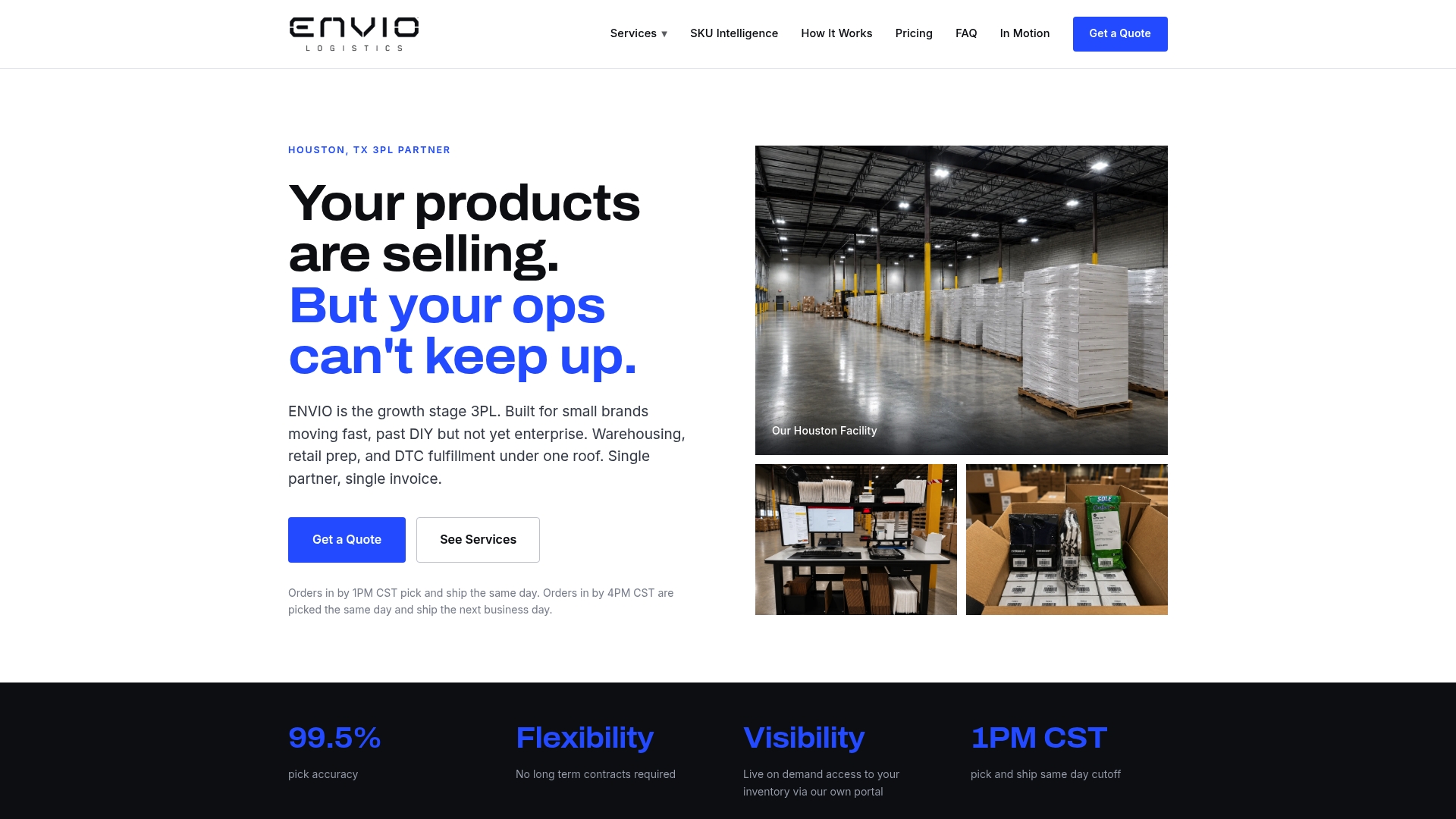
Our services cover the full fulfillment stack, including standard pallet storage, DTC single-unit and small parcel orders, and kitting, labeling, and multipacking priced per unit. We also handle Amazon and Walmart prep and Seller Central account management for brands selling across multiple channels.
- Live inventory data replaces the need for a separate WMS dashboard.
- Same-day shipping on orders placed by 1PM CST keeps fulfillment speed competitive with in-house automation.
- No long-term contracts mean you can test fit with a short pilot before committing.
If your order volume is still growing and a software implementation feels premature, a 30 to 90 day pilot with our 3PL and warehousing team shows what fulfillment looks like without the upfront software cost. Reach out to get a quote and see if outsourcing fits better than buying right now.
FAQ
What is the most popular WMS?
Popularity depends on the buyer segment: among enterprise platforms, Oracle Fusion Cloud Warehouse Management and SAP Extended Warehouse Management carry the strongest analyst presence, while Capterra’s review data shows NetSuite, Odoo, and Fishbowl among the most reviewed options for small and mid-size buyers.
Does Microsoft have a WMS?
Yes. Microsoft offers warehouse management capabilities through Dynamics 365 Business Central and related Dynamics 365 Supply Chain Management extensions, aimed at companies already standardized on the Microsoft ecosystem.
Which WMS does Amazon use?
Amazon runs a proprietary, in-house warehouse management system built specifically for its own fulfillment network rather than a commercially available product. Brands selling on Amazon’s marketplace use separate inventory tools, or a fulfillment partner, to manage their own stock feeding into Amazon’s system.
How much does WMS software typically cost?
Pricing shapes vary by vendor: some charge per user or per warehouse license, others bill by order volume or storage pallet. Rather than a software subscription, outsourced fulfillment options like ours price per service, for example $25 per month per pallet for standard storage, which some brands find more predictable than a tiered software contract.
What should small businesses check before buying a WMS?
Small businesses should confirm integration with their existing ecommerce platform, check whether pricing scales with order volume, and estimate total implementation time before signing. For brands still scaling, piloting a fulfillment partner alongside a software evaluation can clarify whether a full WMS purchase is necessary yet.
Sources
- Gartner Magic Quadrant & Critical Capabilities | Gartner
- The Warehouse Management Systems Landscape, Q2 2026 | Forrester
- Best Warehouse Management Software | Capterra
- Oracle Named a Leader in Gartner® Magic Quadrant™ for Warehouse Management Systems for 11th Consecutive Year
0 comments